>>Read the complete, in-depth November 2026 Edition HERE
KEY HIGHLIGHTS
CORN
In their November update, USDA cut US 2026 corn production by 141 million bushels to 15.893 billion, 70 million below expectations.
The average US yield was cut by 1.6 bushels per acre to 179.6 with no changes to harvested acres.
Yields were down 10 bushels per acre in Michigan, 8 in Illinois, 5 in Indiana and Missouri, and 4 in Nebraska. Yields increased by 9 bushels per acre in Minnesota.
US 2026/27 ending stocks were cut by 91 million bushels to 1.758 billion, 82 million below expectations.
SOYBEANS
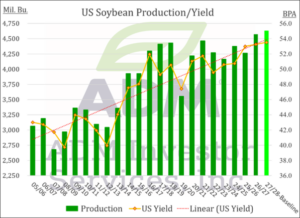
USDA increased its US 2026 soybean production estimate by 12 million bushels to 4.574 billion, 23 million below expectations.
The average US yield was increased by 0.3 bushels per acre to 53.3, with no changes to harvested acres.
Yields cut 4 bushels per acre in Illinois and 3 bushels per acre in Kansas. Yields were increased by 5 bushels per acre in Minnesota, 3 in South Dakota and Nebraska, and 2 in Iowa.
US 2026/27 ending stocks were cut by 15 million bushels to 300 million, 30 million below expectations.
WHEAT
USDA raised US 2026/27 ending stocks by 3 million bushels to 743 million, in line with expectations.
HRW stocks increased 11 million bushels to 344 million, while white wheat stocks were lowered by 10 million bushels to 70 million.
Global 2026/27 wheat production was increased by 5 million metric tons to 827.5 million. Argentina and Australia were each up 1.5 million tons.
Global ending stocks increased by 5 million metric tons to 281 million versus expectations for a 1 million-ton increase.
COCOA
As of November 16, ICE stocks had reached 3.809 million bags, their highest since May 9, 2024.
Ivory Coast port arrivals totaled 49,000 metric tons for the week ending November 15, down from 105,000 for the same week last year and below the five-year average at 96,000. Cumulative arrivals for the 2026/27 marketing year had reached 313,500 tons, down from 516,000 at this point last year and the lowest in at least eight years.
El Niño threatens to make this year’s dry season more severe than normal, but that remains to be seen. It increases the potential for a strong Harmattan, which typically comes down from the Sahara between December and March and causes a sharp drop in humidity. Farmers in the north said the Harmattan had already arrived there and was moving south.
COFFEE
The USDA FAS office in Brazil raised its forecast for the Brazilian 2026/27 coffee crop to a record 72.5 million bags, up 0.8% from its previous forecast.
They raised the arabica forecast to 49.2 million bags from 47.5 million previously, a 29.5% jump from 2025/26.
Robusta production was lowered to 23.3 million bags from 24.4 million previously due to poor weather in Espirito Santo.
COTTON
March Cotton broke below a six-week consolidation in mid-November to its lowest level since early July.
The November USDA WASDE report put US 2026/27 cotton production at 13.18 million bales, mostly in line with expectation and down from 13.44 million in the October update.
Average yield came in at 775 pounds per acre versus 790 in October.
SUGAR
The sugar market has seen significant technical damage since late October, with the break below the 50-day moving average ushering in a wave of selling. As of November 20, the market had decline 21% from the contract high on October 14.
The fund net long may have declined from record levels in recent weeks, but it was still large enough to leave the market vulnerable to long liquidation.
The weak Brazilian real also pressures sugar on ideas it will boost exports, but there is some debate as to how much they have to sell.
CRUDE OIL
After reaching new contract highs at $103.01 on Friday October 30, January Crude Oil gapped lower the following Monday and hasn’t looked back since, recently falling as low as 80.78, a 19% decline.
Contributing to the selloff were forecasts for a global supply surplus in the 4th quarter of this year, which is a big change in expectations given the ongoing wars in the Middle East and Ukraine.
Exports out of the Persian Gulf region have been surprisingly resilient, thanks to ship to ship transfers, ships shutting off their ATS transponders to avoid detection as they move through the Strait of Hormuz, and increased Saudi pipeline flows to the Red Sea despite attacks on the East-West pipeline.
NATURAL GAS
In late October, nearby natural gas prices fell to their lowest since April and almost to their lowest level since October 2024 on a trend of warmer than normal temperatures in the US brought on by El Nino, but since then the market managed to recover to its highest level since June.
Despite El Nino, there have been occasional periods of seasonably cool temperatures that have supported heating demand. However, the warmer than normal trends have dominated, the cool spells have been relatively fleeting, and there have been few instances of significantly below normal temperatures.
US gas in storage is currently above the five-year average but below year ago levels. As of November 13, storage was 1.6% below a year ago and 2.4% above the five-year average.
LIVE CATTLE
As of November 14, year to date federal cattle slaughter had reached 23,822,400 head, which was down 7.0% from a year prior.
With such a steep drop in cattle numbers, it would be expected that cattle and beef prices would be higher, but this has not been the case. Instead, the choice beef cutout was down $14.54, and select was down $5.49 from a year earlier.
The cutouts would have been much lower had rib primals and demand for prime rib roasts for the December holidays not been considerably higher. Choice rib primals were up $46.48 and select were up $63.13.
LEAN HOGS
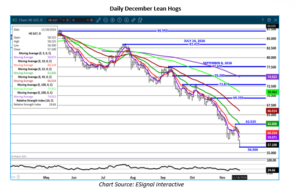
Hogs and pork prices have tumbled since February 2027 Lean Hogs peaked at $86.95 on May 15. They dropped to $76.97 by July 2, and followed with a steeper decline from $77.65 on July 24 to $57.10 on November 18.
Speculators have been active, with open interest increasing as the futures declined. Spread trading has made up a large part of the market, with traders bear spreading Lean Hogs and selling Lean Hogs against Live Cattle.
Increasing weights and increasing slaughter are the reasons prices have dropped.
STOCK INDEX FUTURES
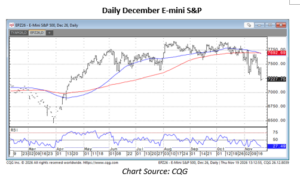
Stock index futures have experienced broad downside trade, as weakness in tech has spread throughout the equity markets. All three major indexes fell in the period between October 21 to November 18, with the Nasdaq -10%, S&P -5.4%, and Dow -2.5%.
The Nasdaq is down roughly 12% since its all-time high on October 6, as an unwinding of the AI trade has pressured the sector, despite Q3 earnings offering robust results.
Sentiment surrounding the AI space has soured somewhat in the wake of the Democratic sweep in Congress. Political/regulatory resistance could slow data center construction and negatively impact returns on AI investments.
CURRENCIES
The US Dollar Index rose roughly 1.7% between October 21 and November 18, largely thanks to a sharp increase in Fed tightening expectations following a run of hot economic data, which reinforced expectations of a Fed hike in December and added to expectations of additional tightening in 2027.
Off-euro flows resulting from France’s fiscal worries and stronger US fundamentals have also supported the dollar. The two-year Treasury yield (4.79%) has risen more than 30 bps in November.
Fed policy expectations will continue to play an outsized role. Expected policy paths in other advanced economies have either moved lower or underwhelmed the US path.
INTEREST RATES
Treasury yields remain below the 24-year highs reached in September, but they have risen sharply across the curve, mainly on the front end. This reflects an increase in Fed tightening expectations.
Yields had fallen earlier in the month, with the 2-year reaching 4.46% and the 10-year 4.84% on November 5, but hotter-than-expected inflation data reversed that move as it raised the possibility of a larger December hike. By November 13, the 2-year had climbed to 4.88% and the 10-year to 5.15%.
The subsequent equity selloff coincided with a partial reversal in yields amid flight-to-quality longs, but it has not erased the month’s repricing.
GOLD
December COMEX contracts have fallen roughly 7% from October 21 to November 18.
Gold is likely to remain under pressure into the December FOMC meeting unless the dollar and US real yields ease.
Another upside inflation surprise could therefore hurt rather than help gold if it pushes real yields higher, which would increase the opportunity cost of holding a non-yielding asset.
COPPER
COMEX copper prices fell roughly 14% from October 21 to November 18. LME prices also experienced sharp declines. Copper remains vulnerable in the near term as weak Chinese industrial demand and doubts about the pace of AI-related infrastructure spending weigh on expectations for consumption.
Falling futures prices are not evidence of an uptick in supply. Shanghai inventories fell 18% in the latest reported week (11/13) to about 27,600 metric tons, and the premium for imported copper hit a record. This points to a shortage of readily available refined metal in China, not necessarily an increase in end-user demand. Indeed, high physical premiums are discouraging downstream purchases among buyers.
This leaves copper exposed to further declines if Chinese demand disappoints and to a sharp rebound if buying improves before inventories rebuild.
Interested in more futures market commentary? Explore our Market Dashboards here.
Risk Warning: Investments in Equities, Contracts for Difference (CFDs) in any instrument, Futures, Options, Derivatives and Foreign Exchange can fluctuate in value. Investors should therefore be aware that they may not realise the initial amount invested and may incur additional liabilities. These investments may be subject to above average financial risk of loss. Investors should consider their financial circumstances, investment experience and if it is appropriate to invest. If necessary, seek independent financial advice.
ADM Investor Services International Limited, registered in England No. 02547805, is authorised and regulated by the Financial Conduct Authority [FRN 148474] and is a member of the London Stock Exchange. Registered office: 3rd Floor, The Minster Building, 21 Mincing Lane, London EC3R 7AG.
Futures and options trading involve significant risk of loss and may not be suitable for everyone. Therefore, carefully consider whether such trading is suitable for you in light of your financial condition. The information and comments contained herein is provided by ADMIS and in no way should be construed to be information provided by ADM. The author of this report did not have a financial interest in any of the contracts discussed in this report at the time the report was prepared. The information provided is designed to assist in your analysis and evaluation of the futures and options markets. However, any decisions you may make to buy, sell or hold a futures or options position on such research are entirely your own and not in any way deemed to be endorsed by or attributed to ADMIS. Copyright ADM Investor Services, Inc.