The new week has a raft of top-level economic data in the US, China, Japan and UK, as well as many central bank speakers, but these seem unlikely to ‘steal the show’ from Nvidia’s Q3 earnings, the reportedly 6x oversubscribed Anthropic IPO and the APEC meeting in China, which will also feature a trilateral meeting between Presidents Trump, Xi and Putin, the latter discussions apparently focusing on limiting nuclear weapons, perhaps Iran, but definitely not Ukraine.
The latter may yield little that is material to the economic outlook and will probably paper over the obvious areas of significant differences. But this is also a moment to step back and reflect on the ‘known known’ weaknesses in the global economic architecture which the past week has again exposed:
a) long-term neglect of infrastructure investment, as per the grounding of flights in the US on Friday;
b) corporate monopolies (above all in the tech sector) that politicians have largely chosen to ignore, aside from the odd EU regulatory skirmish, as per the Microsoft Outlook, Teams and Copilot outage on Friday;
c) cult corporate leadership and the failure to have robust succession plans, as highlighted by the events surrounding Nvidia CEO Huang;
d) media reports alleging that senior members of the US administration had prior knowledge of concerns surrounding Nvidia CEO Jensen Huang.
The latter sits very uncomfortably with one of the top two factors cited by voters that swung the US mid-term elections, namely cost of living and corruption.
For many, this may amount to a lot of ‘whataboutery’, but the level of social unrest in Europe and elsewhere does suggest a clear risk of being antediluvian, particularly when air traffic control systems are in part running on hardware and software from the 1960s to 1980s, and power distribution systems are far from fit for purpose in an age of electrification.
Data Deluge, Central Banks and Earnings
Be that as it may, the barrage of statistics kicks off on Monday with Japan’s Q3 GDP, China’s run of monthly activity and property data, and Canadian CPI, with Japan also looking to National CPI, Trade and Machinery Orders later in the week.
The US has Retail Sales, Industrial Production, Import Prices, NY, Philly and KC Fed Manufacturing and NAHB Housing surveys, while the UK looks to labour data, CPI and PPI, Retail Sales, PSNB and GfK Consumer Confidence; the Eurozone to Q3 Labour Costs, final CPI, Negotiated Wages and Germany’s ZEW survey; while Australia has the Q3 Wage Price Index and Unemployment.
In terms of corporate earnings, outside of Nvidia, the US will look to retailers (Walmart, Home Depot, Target, TJX, Lowe’s), Walt Disney and Palo Alto Networks, while China has Alibaba, Baidu, JD, Lenovo, PDD, Tencent, Xpeng and Zhejiang Leapmotor Technology.
The US FOMC minutes accompany a very busy run of Fed, ECB, BoE and BoJ speakers.
In the commodity space, the IEA’s World Energy Outlook, Asia Copper Week, the USDA’s World Sugar report and various livestock monthly reports may offer some distractions from the persistent attacks on, and disruptions to, energy, food and/or shipping infrastructure and distribution in the Persian Gulf and Red Sea.
China: Politics Likely to Eclipse the Data
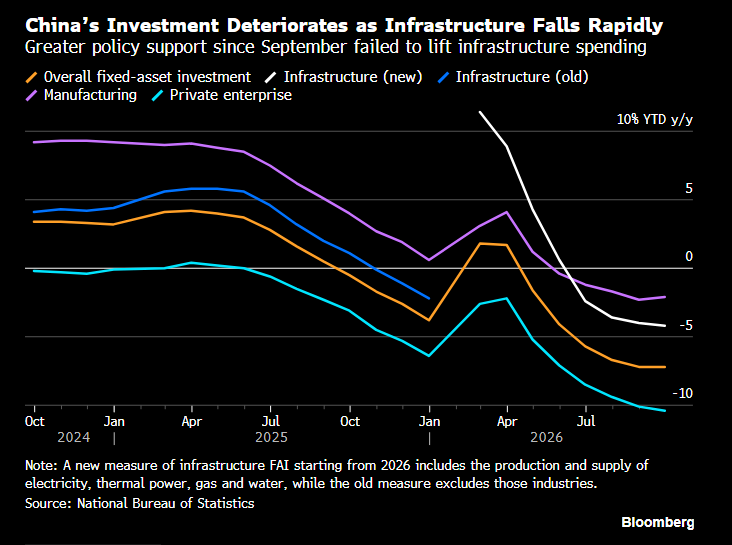
Monday’s run of activity and property data are broadly seen as little changed from September, with Retail Sales seen edging down to 0.8% y/y (from 1.1%), Industrial Production remaining solid at 5.3% y/y (vs. 5.5%), and Fixed Asset Investment woefully weak at -7.0% y.t.d., above all due to a continued hefty drag from Property Investment of -2.0% y.t.d., while the Unemployment Rate is expected to be unchanged at 5.2%.
In other words, a familiar picture of strong external demand compensating for very weak domestic demand in what remains a very imbalanced economy.
But with China hosting the ASEAN meeting and the trilateral China, US & Russia talks, this batch of statistics will likely be no more than statistical roadkill as the focus will be squarely on politics.
Japan: Weak Growth, Sticky Inflation
Q3 GDP is expected to slow sharply to just 0.2% SAAR vs. Q2’s 1.4%, as Net Exports swing from a net 0.5 ppt contribution in Q2 to a -0.5 ppt deduction in Q3, largely reflecting energy, but also raw-materials inflation, along with a small -0.2% q/q contraction in Personal Consumption, in part weather- and quake-related, that also hit Industrial Production.
But there is still expected to be a sharp rebound in Business CapEx to 1.5% q/q following a drop of -0.9% q/q in Q2.
Friday’s CPI is expected to echo Tokyo CPI, with higher energy prices and a weak JPY pushing headline up to 2.6% q/q from 2.1%, though the core ex-food & energy measure is seen unchanged at 2.4%, and per se keeping the BoJ on track for a December rate hike.
October Trade data are forecast to show Exports accelerating once again to 19.9% y/y, though Imports are likely to accelerate faster to 25.8% y/y from September’s 16.5%, again reflecting energy and weak-JPY pressures.
USA: Consumer Spending in Focus
Tuesday’s Retail Sales are expected to slow sharply to just 0.1% m/m after an unexpectedly strong, though largely gasoline-price-boosted, 0.8% m/m in September, with an adverse seasonal adjustment also a headwind. By contrast, the core ‘Control Group’ measure is seen rebounding modestly to 0.3% m/m from September’s 0.1%, reflecting a pick-up in some high-frequency data.
Headline Industrial Production is forecast to slow sharply to 0.1% m/m from a prior 0.7%, mostly due to a drag from extractive industries due to Hurricane Isaias, with Manufacturing Output seen unchanged from September at 0.3% m/m, supported by continued strength in Durables output.
Import Prices are seen up 0.7% m/m (vs. Sept 1.1%) on smaller, though still large, rises in petroleum products, with the ex-Petroleum expected to ease somewhat to 0.4%.
Regional Fed Manufacturing surveys are likely to show continued strength (NY 17.9 vs. Sep 25; Philly 21.5 vs. 20.9), while the NAHB Housing Market Index is seen holding at a 14-year low of 29, as high mortgage rates and affordability challenges continue to keep the residential property sector under pressure.
UK: Inflation and Labour Data Under the Spotlight
Hawkish BoE MPC messaging and a robust Q3 GDP report add considerable sensitivity to this week’s run of UK data.
The latest KPMG/REC employment survey suggested last month’s better-than-expected official data was not necessarily the augur of better labour demand, though forecasts look for a further modest 10K rise in HMRC Payrolls (vs. prior 13K), and a 134K rise in the discredited LFS Employment measures, with headline Average Weekly Earnings projected to ease to 3.5% y/y from 3.7%, but Private Sector Earnings ex-Bonus to edge up 0.1 ppt to 3.1%.
Wednesday’s CPI is expected to see a hefty boost from road fuel costs (>3.0% m/m), pacing a headline rise of 0.5% m/m to edge the y/y rate up 0.1 ppt to 3.6%, but core CPI at an unchanged 2.8% y/y will continue to suggest little in the way of second-round effects, even if Services CPI at 3.8% y/y will remain sticky.
Friday’s Retail Sales ex-Auto Fuel are forecast to be up 0.1% m/m after a choppy Q3 (-0.7%, 0.9%, -0.7%), with the jump in petrol prices and perhaps some pre-Budget-related anxiety restraining spending.
Of particular interest also on Friday will be whether last month’s collapse in GfK Consumer Confidence from -13 to -24 sees any reversal, with the median of -22 assuming only a marginal rebound.
Markets are currently discounting a near-80% chance of a follow-up December BoE rate hike, and this week’s run is likely to prompt some further volatility in UK rate expectations.
Elsewhere: Canada and Australia
Monday’s Canadian CPI is forecast to rise 0.3% m/m on the back of rising gasoline prices, edging up the y/y rate 0.1 ppt to 3.2%, but core measures are all seen at or just below the BoC’s 2.0% target.
Barring an upside surprise on core measures, this would suggest that the BoC will be cautious in raising rates further, implying a rate hold when it meets on 14 December.
This week’s Australian wages and labour data will weigh heavily in the RBA’s December rates decision, with the Q3 Wage Price Index seen accelerating to 1.0% q/q and 3.4% y/y, while October Employment is seen rebounding to +25K after an unexpectedly weak -39.3K drop in September, with the Unemployment Rate unchanged at 4.7%.
Given that the RBA has already hiked rates by 125 bps to 4.85% (i.e. is well ahead of other developed-world central banks), the wages and jobs data would need to beat forecasts to change the view that the RBA will hold rates at its December meeting.
Corporate Earnings Calendar
There are 16 S&P 500 companies reporting this week, with worldwide corporate earnings highlights, as compiled by Bloomberg News, likely to include: Alibaba Group, Baidu, Bank Hapoalim BM, Bank Leumi Le-Israel BM, Bending Spoons, E.Sun Financial Holding, Elbit Systems, Everpure, Experian, Home Depot, Imperial Brands, Intuit, JD, Keysight Technologies, Lenovo, Loblaw, Lowe’s, MS&AD Insurance, NetEase, Nvidia, Palo Alto Networks, Pony AI, Ross Stores, Sompo, SSE, Target, Tencent, TJX, Tokio Marine, Trip.com, Viking Holdings, Walmart, Walt Disney, Weibo, WeRide, XPeng and Zhejiang Leapmotor Technology.