Light schedule of data and events has German Orders and expected OPEC+ output increase to digest ahead of US Services ISM, and handful of central bank speakers.

- Germany: better than expected Orders flattered by surge in defence transport
- USA: Services ISM seen edging lower to still robust level, Prices Paid seen falling sharply, but still somewhat lofty
- Week Ahead: light run of major data, focus on Fed and ECB minutes, China inflation, Japan wages and household spending, German trade and production; busy run of energy and agricultural monthly reports
- Today’s the day: Listen in to the ‘N@ked Short Club’ on Resonance FM at 21:00-22:00 BST tonight for a lively discussion on macro topics, AI, Energy, Sustainability and Infrastructure, with Dr Stu and a great panel of guests!
Q2 The Ghost In The Machine – Out Now
EVENTS PREVIEW
The day’s data schedule is rather light, primarily a case of digesting German Factory Orders and waiting for this afternoon’s US Services ISM, and accompanied by a sprinkling of central bank speakers. In terms of the weekend news (outside of the excitement of the World Cup), South Korea’s intention to set up a ‘Future Response Fund’ out of the surge in AI-related tax receipts to fund major investment projects and improve competitiveness encouragingly demonstrates that at least some politicians are able to think outside of the constraints of the immediate political cycle.
German Factory Orders were significantly better than expected at 1.9% m/m, though the 3-month average remained slightly negative at -0.3% q/q. However, closer inspection highlights a big boost from defence transport orders, and that excluding that would have left Orders down 1.0% m/m as per accompanying comments from Destatis. Today’s delayed US Services ISM is expected to ease modestly to a still solid 54.0, though Prices Paid are forecast to fall more sharply to a still lofty 67.5 from May’s 71.3, while Orders are seen holding at a robust 56.8 from 57.3.
RECAP: The Week Ahead – Preview:
The new week is quite light in terms of statistics, though there are the ECB and Fed policy meeting minutes, numerous central bank speakers and a likely tense NATO leaders meeting (with US President Trump attending) , and the first trickle of US Q2 earnings via way of Pepsico and Delta Airlines, and Shell’s Q2 trading update. Statistical highlights include US Services ISM, German Orders, Production and Trade, China CPI, PPI and possibly Credit Aggregates, Japan Wages, Household Spending and PPI, Canadian labour data and the BoC Q2 Business Outlook survey, and inflation data in Brazil and Mexico.
Negotiations between the US and Iran on a more concrete peace deal continue to drag on with little real progress amid intermittent skirmishes, while the 4 year conflict in the Ukraine continues with both sides focused on attacking energy and other infrastructure. Both conflicts and the one in Lebanon, will doubtless be the main talking points at the annual Chatham House gathering this week.
OPEC+’s decision to raise output a further 188K bpd in August was both expected and largely of little relevance, as tanker and other shipping traffic through the Strait of Hormuz picks up only slowly, while inventories continue to languish at very low levels. Judging by CFTC data on energy positions, markets remain very bearish on oil, though less so on key refined products and Natural Gas.
Meanwhile, Europe, the US and South Asia continue to endure major summer heatwaves which continue to break temperature records, with the brief respite over the past week in Europe set to end, with daytime temperatures in Northern Europe set to remain well above 30C for much of the coming week.
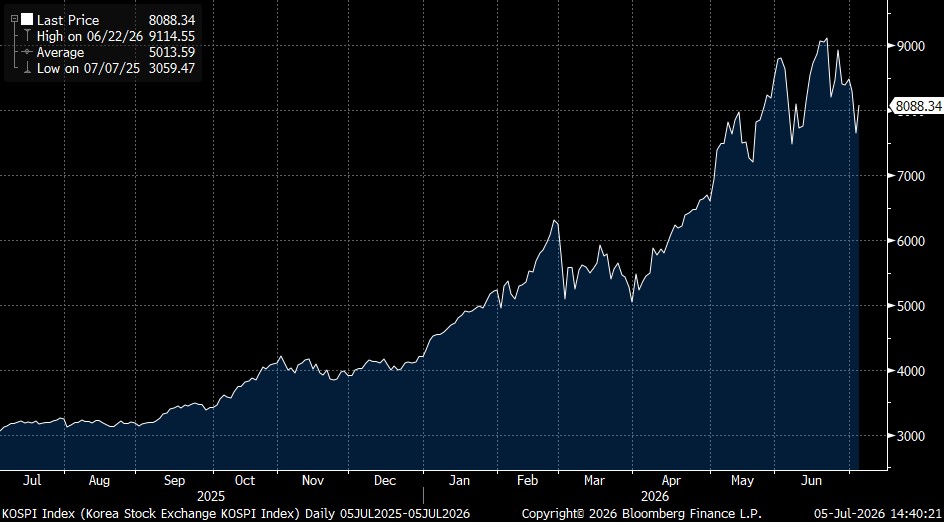
While a great deal of optimism remains around AI investment-led growth, the balance of opinions as viewed through the lens of equity market performance remains rather more fluid and fickle, with South Korea’s KOSPI index seemingly the standard-bearer for current AI-related volatility (see chart).

ECB and Fed minutes: Both sets of minutes will be scanned for hints on the rate outlook, even as Warsh and, perhaps more surprisingly, Lagarde argued for less forward guidance at last week’s Sintra Forum on Central Banking. To a certain extent, both are now somewhat historical given the slide in oil prices back to pre-February 28 levels, though the sharp divergence between Oil and Gasoline prices does underline that energy pipeline pressures remain a real threat (see chart). Given a very terse Fed statement, the risk is that the FOMC minutes will also be less detailed, but they should at least offer some insights into how many FOMC members are shifting to the view that a rate hike will likely be necessary. While Lagarde has stuck to her signal of another rate hike (likely in September), as well as touting signs of greater growth resilience in the face of the energy price shock, other ECB speakers have been rather more ambivalent since the June 10/11 meeting, especially given the fall in June CPI. Elsewhere, only New Zealand’s RBNZ is expected to hike rates this week, predicated largely on the very close vote to hold at its May meeting, though the sharp fall in oil prices, and the fact that Q2 CPI will only be published on 20 July, with a forecast update due at its August meeting may possibly defer a rate hike to August. Rates are seen on hold in Egypt, Malaysia, Peru, Poland, Romania and Serbia, while the Bank of Israel is seen cutting rates 25 bps to 3.50%.
USA: Last week’s Payrolls were weaker than expected, but even with the net -74K downward revision to prior months, the 3-mth average at 111K remains above the Fed’s equilibrium (breakeven) rate of 80-100K, and the Fed must be somewhat alarmed by the sharp fall in the Labour Participation Rate over the past 9 months (see chart) to the lowest level since the start of the pandemic. Given that gasoline prices remain elevated, it will be interesting to see how much further easing there will be in the NY Fed’s 1-yr Inflation Expectations (last 3.46%). Trade Balance and Existing Home Sales will be the only other points of interest.
China: While CPI is expected to ease marginally to 1.1% y/y on a combination of continued falls in Food Prices, soft consumer goods inflation (on the back of weak demand) and the fall in energy prices, the consensus surprisingly sees PPI climbing to 4.2% y/y from 3.9%. While there is a modest adverse base effect (June 2025 PPI dropped to -3.6% y/y from -3.3% in May), the falls in energy, metals and agricultural prices (in some cases quite sharp) between May and June should more than offset this, with the risk of a quite sharp fall being substantial.
Germany: the inherently very volatile Factory Orders are expected to rebound 1.1% after sliding -3.8% in April, with the much anticipated support from federal government spending on Infrastructure and Defence proving to be weaker, and offset by demand destruction due to the Persian Gulf energy price shock, leaving the underlying trend no better than flat. April’s 0.4% m/m rebound in Industrial Production followed declines of -0.1%, -0.2%, -0.3% and -0.4%, with forecasters looking for a tepid 0.1% in May, which would imply a modest positive contribution from manufacturing to Q2 GDP, but this may be offset by weak consumer spending and business investment due to energy prices. A similarly weak picture is also anticipated from this week’s Trade data, with Exports seen dipping -0.4% m/m and Imports -0.8% m/m after a stronger than expected rebounds in April of 0.9% and 1.2% m/m respectively. As much as Chancellor Merz has been touting the recent coalition agreement on reforms to the pension system, fixed-term contract legislation and reducing red tape, and upscaling its Germany Fund into a strategic investment vehicle intended to attract more private capital, the proof of the pudding is in the eating, above all in terms of reducing very burdensome planning procedures. Scepticism remains justified.
Japan: The focus remains on PM Takaichi’s spending plans above all, given Japan’s very strained fiscal position, and on the fate of the JPY above all due to the BoJ remaining well behind the curve on rates relative to underlying inflation. Per se, this week’s Labour Cash Earnings, seen easing 0.2 ppt to 3.4% y/y in nominal terms and to 1.8% in real terms mostly due to calendar effects from fewer working days in May 2026 relative to May 2025, will likely have little material impact. Of greater concern should be Household Spending, which has been negative in y/y terms for the past 5 months, and is expected to have fallen -2.3% y/y in May, though that will be heavily exaggerated by base effects given a transitory surge in May 2025 of 4.7% y/y.
Commodities/Energy: monthly reports for the Oil sector from the US EIA and the IEA, and a host of Agricultural S&D reports in the US (WASDE), China (CASDE), Brazil (Unica Sugar), Malaysia (MPOB) and Australia (Grain Industry Association of Western Australia) will make for a busy week. They are accompanied by the International Gas Union’s webinar on its latest World LNG Report, Shanghai Platinum Week and Asia Climate Week conferences.
There is just one S&P 500 company reporting this week, with worldwide corporate earnings highlights as compiled by Bloomberg News likely to include: Asahi Group, Delta Air Lines, Fast Retailing, Nanya Technology, PepsiCo, Qatar National Bank QPSC, Seven & I, Tata Consultancy Services and Yaskawa Electric.
To view the full report and to sign up for daily market commentary please email admisi@admisi.com
Disclaimer:
This material is provided for information purposes only and does not constitute investment advice, a recommendation, or an offer to buy or sell any financial instrument. The views expressed reflect market conditions and publicly available information as of the date of writing and may change without notice. No representation or warranty is made as to the accuracy or completeness of the information. Past performance is not indicative of future results. Readers should consider their own circumstances and, where appropriate, seek independent financial advice.
Risk Warning: Investments in Equities, Contracts for Difference (CFDs) in any instrument, Futures, Options, Derivatives and Foreign Exchange can fluctuate in value. Investors should therefore be aware that they may not realise the initial amount invested and may incur additional liabilities. These investments may be subject to above average financial risk of loss. Investors should consider their financial circumstances, investment experience and if it is appropriate to invest. If necessary, seek independent financial advice.
ADM Investor Services International Limited, registered in England No. 02547805, is authorised and regulated by the Financial Conduct Authority [FRN 148474] and is a member of the London Stock Exchange. Registered office: 3rd Floor, The Minster Building, 21 Mincing Lane, London EC3R 7AG.
A subsidiary of Archer Daniels Midland Company.
© 2026 ADM Investor Services International Limited.
Futures and options trading involve significant risk of loss and may not be suitable for everyone. Therefore, carefully consider whether such trading is suitable for you in light of your financial condition. The information and comments contained herein is provided by ADMIS and in no way should be construed to be information provided by ADM. The author of this report did not have a financial interest in any of the contracts discussed in this report at the time the report was prepared. The information provided is designed to assist in your analysis and evaluation of the futures and options markets. However, any decisions you may make to buy, sell or hold a futures or options position on such research are entirely your own and not in any way deemed to be endorsed by or attributed to ADMIS. Copyright ADM Investor Services, Inc.