Written Commentary

The week gets off to a relatively quiet start in terms of statistics, with a further surge in South Korean Exports paced by a 259.4% y/y increase in Chip Exports (but remember this is a value, not a volume measure) to digest, along with the German state elections results, as the conflicts in the Middle East and the Black Sea show no signs of easing. In point of fact, neither EUR/USD, which is barely changed, nor Bund yields, which are a little lower on the back of the fall in Oil prices, have shown any reaction to the German political news, with the French election a much larger concern, along with energy prices.
The meeting of US and Chinese officials ahead of the Trump/Xi summit did not reach any agreement on extending the current trade truce, with the US evaluation that the talks were frank and constructive amounting to nothing more than a platitude, but at least dialogue continues, without any threats of escalating tensions.
A late-morning speech by the Chicago Fed’s generally ‘middle of the road’ Goolsbee looks to be the scheduled highlight of the day, as markets look for clues on the timing of the next Fed rate hike, and follows typically hawkish Kashkari yesterday.
The new week is very light in terms of data: primarily flash PMIs, Ifo and numerous other surveys, US Durable Goods Orders & New Home Sales, Australian Unemployment and UK PSNB; but very long on central bank speakers as well as commodity conferences, with the Trump-Xi meeting the other key political and trade focal points, as the conflicts in the Middle East and around the Black Sea continue, and Germany’s two state election results to digest, and the UN annual General Assembly also on tap.
Concerns around AI safety and security are countering some of the AI investment euphoria, while energy prices continue to gyrate and make for a very uncertain inflation and interest rate outlook. Despite all of that, measures of financial market volatility are either at rock bottom (US and Europe equity indices), or very subdued on any historical comparison (e.g. MOVE Treasury or FX CVIX), with credit spreads remaining tight, even if somewhat higher than earlier in the year, despite record levels of issuance. Per se there remains a seemingly large disconnect between the financial and real economy.
There will also be some holiday disruptions in Asia, above all in Japan which will be closed Monday through Wednesday, while China, South Korea and Taiwan are closed on Friday.
There are 9 Fed, 13 ECB and 3 BoE policymakers scheduled to speak this week as markets try to work out their respective rate trajectories, with Switzerland’s SNB (0.0%) and Sweden’s Riksbank (1.75%) set to hold rates, while Norges Bank is seen hiking rates a further 25 bps to 4.50%, though that decision is seen as finely balanced.
Given Warsh’s refusal to offer guidance, it will be down to other FOMC members to offer some hints on the probability and timing of further rate hikes, with markets currently 50/50 on October, fully priced for a further hike in December and another by June 2027. Markets are also discounting three further ECB rate hikes by April, the BoE to hike every quarter until Q3 2027, and the BoJ to hike rates twice by June – all of which is also well discounted in respective 2-yr yields.
Markets are erring on the cautious side, i.e. probably expecting more than may actually materialize. But rate expectations will remain quite volatile, fluid and even fickle for a protracted period, given a lot of uncertainty about energy prices, the economic outlook and the future path of AI investment.
Elsewhere China’s monthly Loan Prime Rate fixings were left unchanged (1-yr 3.0%, 5-yr 3.50%) on Sunday as expected, which fits with expectations of no major new stimulus, and fitting with PBOC governor Pan Gongsheng recently opining that weak loan growth is likely to be the ‘new normal’, and with authorities seemingly relying on ‘organic’ support from rising corporate bond and equity issuance.
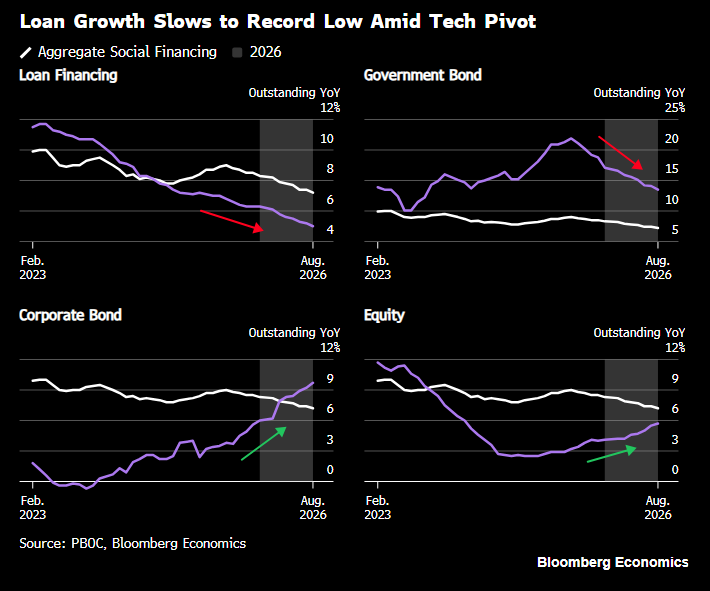
With the expiration of the US/China ‘trade truce’ due in early November, the question is whether this will be extended for another year as the consensus expects, though there has been talk of it being extended for a shorter period, as the US seeks to pressure China into concessions (better flow of critical minerals, more China purchases of US agricultural goods inter alia).
The outcome of the meeting between Bessent, Greer and He should offer some clues, even if the close proximity to the Trump/Xi meeting suggests some back-door brinkmanship. The relationship between the two countries certainly remains strained, though neither side appears to want to see a re-escalation, even if there have been some sharply worded statements about sanctions on Iran and Russia, AI regulation and equipment investment, and security risks in the Pacific region from both sides.
Markets are certainly hoping for a smooth and largely uneventful meeting, which will still leave many areas of tension very much unresolved, and again kicked into the long grass.
The preliminary results were pretty much as bad as many had expected for the mainstream CDU and SPD. Merz’s CDU barely scraped above the 5% entry hurdle in Mecklenburg-Vorpommern in provisional results, with AfD on 37.9% edging out the ruling SPD on 35.7%, with Die Linke (far-left) on 6.7% and Greens 5.4% also making the cut – a left-wing coalition is therefore possible, or SPD, CDU and Green, but both would be difficult.
The latter is also a possibility in Berlin, where the vote was more evenly fractured: Die Linke 25.3%, CDU 19%, AfD 16.3%, Greens 14.4% and SPD 12.1%, but again any 3-way coalition will be difficult to form let alone sustain.
While Merz has again refused to step down, despite again describing the elections a ‘disaster’, the lack of challengers looks to be primarily a case of no one wanting to take over a very poisoned chalice (itself a testament to a political leadership vacuum). But the fact is that Merz is deeply unpopular and will almost certainly face a challenge for the leadership over the next year, with the April 2027 state vote in Nordrhein-Westfalen potentially a pivotal moment, given that if the popular state premier Wuest does well (against national trend), many would push for him to challenge Merz, and if the CDU do badly, the blame will fall squarely on Merz.
Just for reference, while Mecklenburg-Vorpommern is geographically large (sixth largest in Germany), it has a small population of just 1.63 Mln (third smallest) and like Sachsen-Anhalt is a poor proxy for national trends. By contrast Berlin, despite this election being heavily influenced by housing policies, can be said to be broadly reflective of national trends, and dare I say it Germany is sadly looking ever more Weimar-esque.
Forecasts for the run of PMIs assume marginal dips for Manufacturing PMIs and little change for Service, with the focus given the high energy prices on price sub-indices, as well as on Orders as a proxy for AI investment paced growth resilience.
Germany’s Ifo survey is expected to improve very modestly again, both on expectations (89.3) and current situation (89.0), though those absolute levels remain historically very weak.
One can make the observation that hard economic data has shown a good deal more resilience than surveys (outside of the US) have implied, and that this is unsurprising given the level of outlook uncertainty due to geopolitical tensions and fragmentation, and ongoing rapid technological development. That said, the numerous economic and social imbalances across the world remain a threat that should not be dismissed.
In the commodity space, there are various monthly USDA livestock reports, but outside of a continued focus on energy prices, there are also a lot of conferences: China’s International Steel Congress, Brazil’s Rio Oil & Gas, Indonesia’s Enlit Asia Power & Energy, France Gaz congress, Germany’s WindEnergy Hamburg, US Climate Week NYC, Bloomberg NY Green event and Women in Agribusiness Summit, and Energy Trading Week Europe in London.
There are 6 S&P 500 companies reporting this week, with worldwide corporate earnings highlights as compiled by Bloomberg News likely to include: AutoZone, Cintas, Costco Wholesale, H&M Hennes & Mauritz, Paychex.